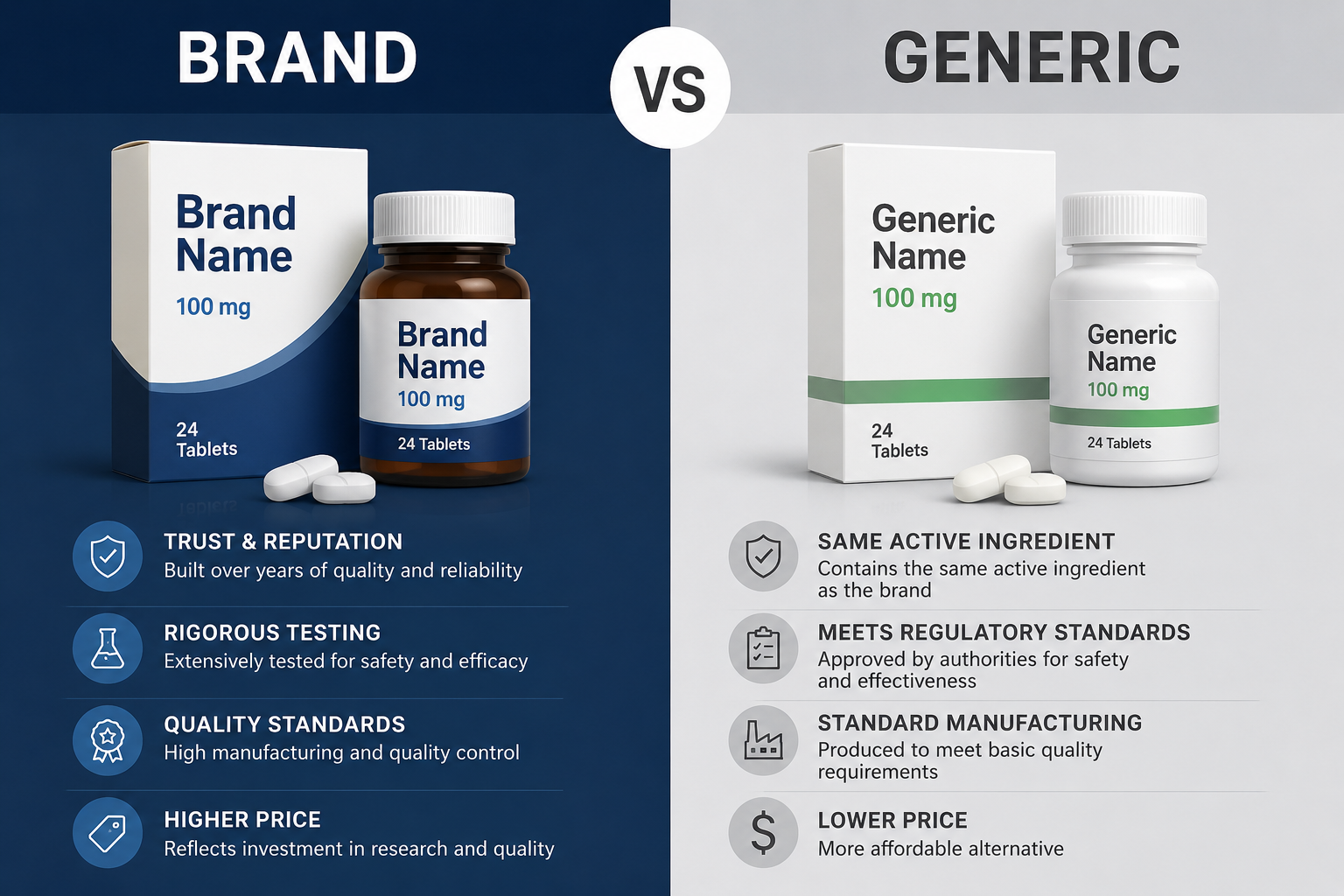
You’re standing at the pharmacy counter. The pharmacist hands you a receipt and you notice the price: $180 for a brand-name drug your doctor prescribed. Then they mention there’s a generic version for $12.
Same drug. Different price. What’s going on?
This question confuses millions of Americans every year. And the answer — while mostly reassuring — has a few nuances worth knowing before you make a decision.
What Makes a Drug “Brand-Name”?
When a pharmaceutical company develops a new drug, they patent it. That patent gives them the exclusive right to sell it — usually for around 20 years. During that time, they market it under a brand name: Prozac, Advil, Lipitor, Zoloft.
They choose the name. They design the packaging. They set the price. And since no one else can legally make the same drug during the patent period, they have little competition.
That’s why brand-name drugs are expensive. Companies spend billions on research, clinical trials, and FDA approval — and they recover that investment during the patent window.
What Happens When the Patent Expires?
Once the patent expires, other manufacturers can apply to make their own version of the drug. These are called generic drugs.
To get FDA approval, a generic manufacturer has to prove that their version:
- Contains the same active ingredient
- Is the same strength and dosage form (pill, capsule, liquid, etc.)
- Works in the same way in the body
- Meets the same safety and quality standards
This process is called demonstrating bioequivalence — meaning the generic performs equivalently to the brand-name drug in your body.
Are Generic Drugs Actually the Same?
The active ingredient — the chemical that actually treats your condition — is identical. There is no legal or regulatory pathway to approve a generic that uses a different active ingredient.
What can differ:
- Inactive ingredients (fillers, binders, dyes, coatings)
- Appearance (color, shape, size)
- Manufacturer and facility
The inactive ingredients are generally considered inert — they don’t affect how the drug works. However, in rare cases, certain fillers can affect how quickly the drug is absorbed, which matters more for some medications than others.
For the vast majority of drugs — think common antibiotics, blood pressure medications, antidepressants, cholesterol drugs — the generic works just as well as the brand-name version.
When Might Brand-Name Matter?
There are a small number of situations where the distinction becomes more relevant:
1. Narrow therapeutic index drugs Some medications require very precise dosing — small differences in absorption can have real effects. Examples include warfarin (a blood thinner), levothyroxine (thyroid hormone), and certain seizure medications. For these, some doctors prefer patients stay consistent with one manufacturer.
2. Extended-release formulations The inactive ingredients in extended-release tablets help control how slowly the drug releases into your system. Different formulations can behave slightly differently, though generics still must meet FDA bioequivalence standards.
3. Individual sensitivity A small number of people report responding differently to a generic after switching. This is uncommon, and often not confirmed in clinical settings — but it’s worth discussing with your doctor if you notice changes after switching.
Bottom line: For most people, most of the time, the generic is clinically equivalent to the brand-name drug.
Why Is There Such a Big Price Difference?
Generic manufacturers don’t have to repeat the original clinical trials. They don’t have to prove the drug is safe and effective from scratch — that’s already established. They just have to prove their version behaves the same way.
This dramatically lowers their development costs. And because multiple companies can make the same generic, competition drives prices down further.
The result: generics typically cost 80–85% less than their brand-name equivalents. The FDA estimates that generic drugs saved the U.S. healthcare system over $300 billion in a single year.
How to Know If a Generic Is Available for Your Medication
Your pharmacist is the fastest resource. You can also:
- Ask your doctor to write “substitution permitted” on your prescription
- Look up your drug on the FDA’s Orange Book — the official database of approved drug products
- Use a prescription savings tool to compare prices across pharmacies before you fill
Prices for the same generic can vary significantly from one pharmacy to another, even within the same city. These tools are free, take about 30 seconds to use, and can save you real money — sometimes hundreds of dollars a year on a daily medication:
- GoodRx — the most widely used option, covers 70,000+ pharmacies nationwide. Search your drug, get a coupon, show it at the counter. Works even if you have insurance (sometimes the coupon price beats your copay).
- SingleCare — no account required to search. For some medications like common generics, SingleCare frequently offers lower prices than GoodRx — so it’s worth checking both before you fill. SeniorSite
- RxSaver — another solid price comparison tool that lets you search local pharmacies and access discount coupons, with a clean interface that’s easy to use on mobile. Consainsights
It’s a common misconception that these tools are only for the uninsured — in many cases, the coupon price is lower than an insurance copay, particularly for generic drugs or high-deductible plans. Even pharmacists use them behind the counter. Onward Living HQ
Should You Ask Your Doctor to Switch?
If you’re currently on a brand-name drug, it’s worth having the conversation — especially if cost is a factor. Most doctors are open to it, and for the majority of medications, there’s no clinical reason to stay on the brand-name version once a generic exists.
Questions to ask your doctor:
- “Is there a generic available for this medication?”
- “Is there any reason I specifically should stay on the brand-name version?”
- “If I switch, what should I watch for?”
If your doctor says there’s no reason to avoid the generic, the savings are usually straightforward.
The Bottom Line
Generic drugs contain the same active ingredient as brand-name drugs, are regulated by the same FDA standards, and for most people work just as effectively. The price difference isn’t about quality — it’s about economics.
If you’re paying full price for a brand-name drug that has a generic available, you may be leaving significant savings on the table. A conversation with your pharmacist or doctor — and a quick price comparison — takes less than five minutes and could save you hundreds of dollars a year.